
Memorials Where Buxton War Dead are Commemorated
 At the end of The Great War (1914-19) came the mammoth task of identifying hundreds of thousands of war dead, many of whom had been hastily buried in ad-hoc battlefield graves, or whose war records were inaccurate, fabricated or, at times, missing entirely.
MEMORIALS:
The Commission had also been mandated to individually commemorate each soldier who had no known grave, which amounted to 315,000 in France and Belgium alone. The Commission initially decided to build 12 monuments on which to commemorate the missing; each memorial being located at the site of an important battle along the Western Front.
After resistance from the French committee responsible for the approvals of memorials on French territory, the Commission revised their plan and reduced the number of memorials, and in some cases built memorials to the missing in existing cemeteries rather than as separate structures.
 Reginald Blomfield‘s Menin Gate was the first memorial to the missing located in Europe to be completed, and was unveiled on 24 July 1927 (right). The Menin Gate (Menenpoort) was found to have insufficient space to contain all the names as originally planned and 34,984 names of the missing were instead inscribed on Herbert Baker‘s Tyne Cot Memorial to the Missing.
 Other memorials followed: the Helles Memorial in Gallipoli designed by John James Burnet; the Thiepval Memorial (left) on the Somme and the Arras Memorial, both designed by Edwin Lutyens; and the Basra Memorial in Iraq designed by Edward Prioleau Warren.
WW2 saw new Memorials – see below
Second World War:
From the start of the Second World War in 1939, the Commission began planning ahead based on the experience gained from the First World War, and earmarked land for use as cemeteries.
When the war began turning in favour of the Allies, the commission was able to begin restoring its First World War cemeteries and memorials. It also began the task of commemorating the 600,000 Commonwealth casualties from the Second World War, and in different Theatres of War, in far flung parts of the World.
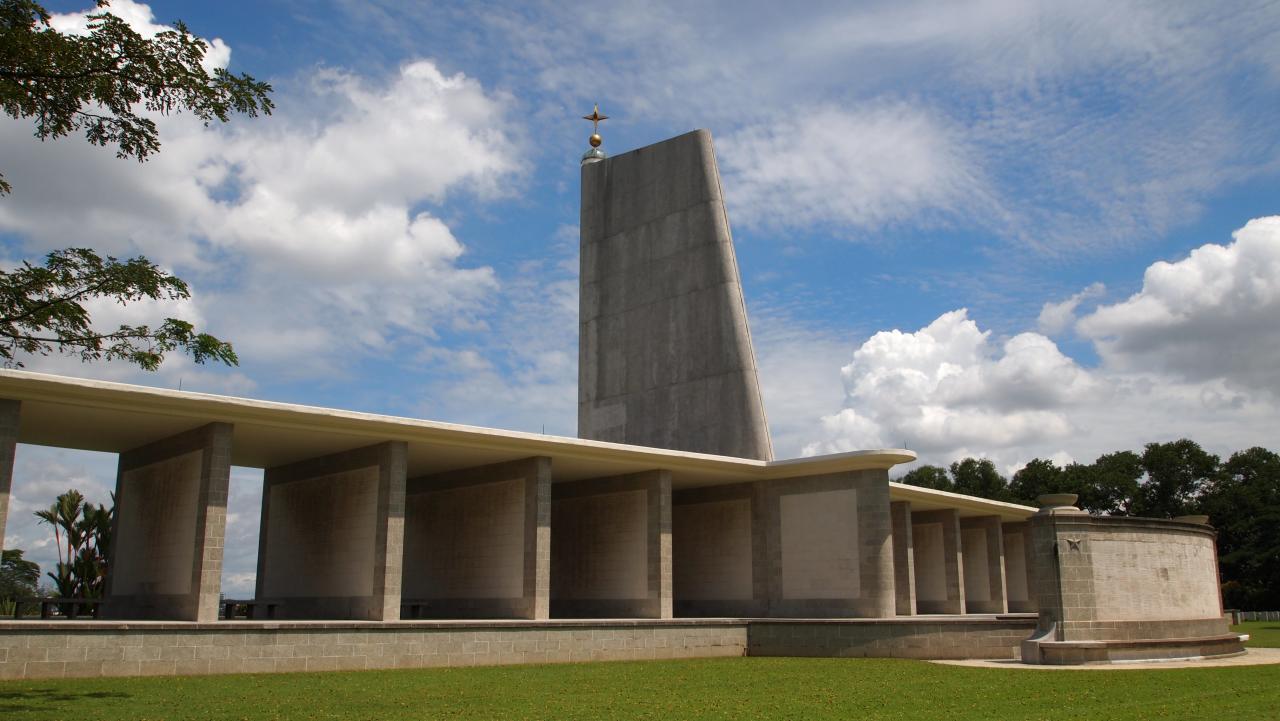 This, of course, included new sites for Memorials in Africa and The Far East, such as The Kranji War Memorial, in Singapore, commemorating 24,306 casualties (right).
In 1960 the “Imperial War Graves Commission” [IWGC] was renamed the “Commonwealth War Graves Commission” [CWGC].
 .. a fuller account of the foundation and responsibilities of the Commission is on our “Cemeteries” page.
Buxton War Dead:
It is amazing that, for such a small town, the men and women who gave their lives in the two World Wars and shave no known graves, are commemorated all over the World on a total of 31 Commonwealth War Grave Memorials to the Missing (23 from WW1 and 8 from WW2).
The biggest difference between the two conflicts lies in their locations. Whereas most of the Word War 1 commemoration are in France and Belgium, in World War 2 the locations move to Africa and the Far East.
World War 2 also sees a rise in the Memorials to Royal Naval and Royal Air Force personnel.
The Memorials where Buxton men and women can be found from the MENU BAR above, divided into:
-
-
- World War 1 (WW1) Memorials, and
- World War 2 (WW2) Memorials.
-
Using the links from these pages on the MENU BAR above you can explore on which Memorial each of the Buxton casualties were Commemorated.
 .. this site’s ‘Cemeteries‘ page for access to the CWGC sites where Buxton’s War Dead are buried.
|
Sources:
|
