
Cemeteries Where Lie the Buxton War Dead
At the end of The Great War (1914-19) came the mammoth task of identifying hundreds of thousands of war dead, many of whom had been hastily buried in ad-hoc battlefield graves, or whose war records were inaccurate, fabricated or, at times, missing entirely.

“Never had a nation, let alone an Empire as vast and multicultural as the British Empire, attempted to commemorate all its war dead from a given conflict. No template existed for the task of commemorating the dead on such a mammoth scale. Everything we now take for granted, every facet of remembrance, had to be worked out, debated, costed and delivered.” [History of the CWGC]
COMETH THE HOUR…
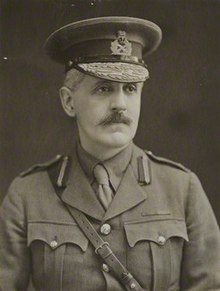 At the age of 45, Fabian Ware (left) was too old to fight when the First World War started in 1914 but he was determined to “do his bit”.
He became the commander of a mobile unit of the British Red Cross – initially attached to the French sector of what we now call the Western Front.
 Fabian was shocked by what he found. The sheer number of casualties was without precedent. There was no system in place to bury the dead or record or mark their final resting places.
If men were buried, it was usually by their comrades and their grave markers, a temporary wooden cross. Many more bodies were simply left where they were – unreachable in no man’s land.
Encouraged by the Prince of Wales, he submitted a memorandum to the Imperial War Conference in 1917 suggesting such an organisation be created. It was unanimously approved and so the Imperial War Graves Commission was established by Royal Charter on 21 May 1917, with the Prince serving as President and Ware as Vice-Chairman.
 The Commission set the highest standards for all its work. Three of the most eminent architects of the day – Sir Edwin Lutyens, Sir Herbert Baker and Sir Reginald Blomfield – were chosen to begin the work of designing and constructing the war cemeteries and memorials. Rudyard Kipling was tasked as literary advisor to recommend inscriptions.
Pictured above right is Lutyen’s entrance to the Villers-Bretonneux Military Cemetery & Australian National Memorial, Fouilloy, France.
Lutyens was also responsible for the iconic design of the “Cross of Sacrifice” and “Stone of Remembrance” (“Great altar stone” – Lutyens) found in every I(C)WGC Cemetery.

Ware asked Sir Frederic Kenyon, Director of the British Museum, to interpret the differing approaches of the principal architects. The report he presented to the Commission in November 1918 emphasised equality as the core ideology by which it should operate.
 The dead were to be buried where they fell – there would be no repatriation of remains – and rather than a cross, a standard headstone would be used to mark their graves. For those with no known grave, great memorials to the missing would be erected to ensure they would also be remembered.
In all cases, no distinction would be made between those lost – as their sacrifice had been common, their commemoration would be common also.
 The example above shows a Victoria Cross holder of the South Staffs.Regiment, Pt. 17114 Thomas Barrett, lying next to Pte. 40614 W.J Underwood in Graves I.Z.8 and 9, Essex Farm Cemetery. They died together on 27th July 1917.
At home, the very idea of commemorating all the dead in the same way was considered controversial. Some families maintained their own ideas of how they wanted to mark the graves of their loved ones and were desperate to bring them back. They railed against the Commission’s policy of non-repatriation.
Nonetheless, after the first “experimental” cemeteries were built in Europe in 1920 and were warmly received by the press, much of the public came to appreciate what Fabian Ware and his fledgling organisation was attempting to create. The Commission then embarked on one of the largest building programmes ever seen.
In 1960 the “Imperial War Graves Commission” [IWGC] was renamed the “Commonwealth War Graves Commission” [CWGC].
Some Facts:
-
-
- The Commission is currently responsible for the continued commemoration of 1,700,000 deceased Commonwealth military service members in 153 countries.
- Since its inception, the Commission has constructed approximately 2,500 War Cemeteries and numerous memorials.
- The Commission is currently responsible for the care of war dead at over 23,000 separate burial sites and the maintenance of more than 200 memorials worldwide.
- In addition to commemorating Commonwealth military service members, the Commission maintains, under arrangement with applicable governments, over 40,000 non-Commonwealth war graves and over 25,000 non-war military and civilian graves.
- The Commission operates through the continued financial support of the member states: United Kingdom, Canada, Australia, New Zealand, India and South Africa.
-
Buxton War Dead:
It is amazing that, for such a small town, the men and women who gave their lives in the two World Wars and subsequent conflicts now lie scattered all over the World in a total of 133 Commonwealth War Grave Cemeteries.

 Those closest lie in the cemeteries of Buxton, Burbage, Fairfield and Harpur Hill, such as Spr. Thorpe in Burbage Churchyard (left).
The furthest – the Far East, India, Africa, as well as the main European theatres of War, in France, Germany and Italy. e.g. Aircraftman Goodwin (right) in Kolkata.
The Cemeteries where Buxton men and women can be found from the MENU BAR above, divided into:
-
- World War 1 (WW1) Cemeteries, and
- World War 2 (WW2) and Subsequent Conflicts, Cemeteries.
Using the links from these pages on the MENU BAR above you can explore in which Cemetery each of the Buxton casualties were buried.
 Many, of course, are “Known Unto God” and are commemorated on the Memorials to those who have no known grave.
 .. this site’s ‘Memorials‘ page for access to the National Memorials for Buxton’s War Dead who have no known grave.
|
Sources:
|
